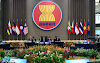
. US President Joe Biden meets by teleconference with Japanese PM Yoshihide Suga, Indian PM Narendra Modi and Australian PM Scott Morrison
. Among other issues discussed, National Security Adviser Jake Sullivan says, are China’s ‘coercion of Australia’ and ‘aggression on the border with India’
 |
US President Joe Biden and the leaders of three major Asia-Pacific countries, an alliance known as the “Quad”, discussed “aggression” and “coercion” against members of the group by China, while agreeing to cooperate on development of 5G and other advanced technologies, in their first summit meeting on Friday.
Biden, Japanese Prime Minister Yoshihide Suga, Indian Prime Minister Narendra Modi and Australian Prime Minister Scott Morrison, meeting by means of large flat-screen televisions, discussed China’s “coercion of Australia, their harassment around the Senkaku Islands, their aggression on the border with India”, US National Security Adviser Jake Sullivan said in a briefing in Washington after the talks.
A statement issued by the group called for the region to be “anchored by democratic values” – and for freedom of navigation and overflight as key objectives – while avoiding any direct reference to China. They also announced a “Quad Vaccine Partnership”, which will provide financing and other assistance to manufacture and distribute Covid-19 vaccines, a move that comes as Washington faces criticism for hoarding the protective jabs.
The Quad – shorthand for the Quadrilateral Security Dialogue – said in the first of five points in the statement that: “We bring diverse perspectives and are united in a shared vision for the free and open Indo-Pacific. We strive for a region that is free, open, inclusive, healthy, anchored by democratic values, and unconstrained by coercion.”
“We support the rule of law, freedom of navigation and overflight, peaceful resolution of disputes, democratic values, and territorial integrity,” the statement says later.
“We will continue to prioritise the role of international law in the maritime domain, particularly as reflected in the United Nations Convention on the Law of the Sea (UNCLOS), and facilitate collaboration, including in maritime security, to meet challenges to the rules-based maritime order in the East and South China Seas,” they added.
The grouping also pledged establish a working group to focus on standard-setting for emerging technologies, including 5G and artificial intelligence; to cooperate on combating the effects of climate change in accordance with the Paris Climate Accord; to address Covid-19 within the World Health Organization (WHO); work towards the complete denuclearisation of North Korea; and seek the restoration of democracy in Myanmar.
“While China is not mentioned in the joint statement, China was everywhere in the document,” said Toshi Yoshihara, a senior fellow at the Centre for Strategic and Budgetary Assessments in Washington, explaining that the group‘s message seemed to be about what it stood for, rather than what it opposed.
“However, behind the polite language lies a stark strategic reality,” Yoshihara said. “The Indo-Pacific naval balance of power is a multilateral one. If you add up the maritime capabilities of Australia, India, Japan and the United States, the correlation of forces shifts quite a bit against China. Beijing understands this all too well.”
On the Covid-19 front – where Beijing has sought to curry favour with its neighbours through the distribution of its vaccines – the four nations announced on Friday their “Quad Vaccine Partnership”. This initiative aims to accelerate the steps needed to end the coronavirus pandemic, according to a fact sheet.
“Together, Quad leaders are taking shared action necessary to expand safe and effective Covid-19 vaccine manufacturing in 2021, and will work together to strengthen and assist countries in the Indo-Pacific with vaccination, in close coordination with the existing relevant multilateral mechanisms, including WHO,” it said.
The meeting came days after Biden released an “interim” national security policy document that stresses the need for Washington to shore up alliances with democratic countries and explicitly calls out China as “the only competitor potentially capable of combining its economic, diplomatic, military and technological power to mount a sustained challenge to a stable and open international system”.
“Diplomacy is back. Alliances are back,” Biden said in the document, an apparent rebuke of the policies of his predecessor Donald Trump, who spent much of his four-year presidency accusing allies in Asia-Pacific, including Tokyo, for not contributing enough to joint military operations in the region.
Rorry Daniels, an Asia-Pacific security analyst at the National Committee on American Foreign Policy, said that the Quad’s joint statement should reassure China’s neighbours, but added that the group’s success does not need to come at China’s expense.
“Only Beijing can change Beijing‘s behaviour,” Daniels said, adding that China would also benefit from more Covid recovery and economic development in the region. “The challenge for China will be whether it wants to recommit to the international rules-based system, even if that commitment comes with some constraints on its use of power.”
Each member of the Quad has been trying to manage escalating tensions with Beijing. Biden has so far left in place US sanctions that Trump instituted against Chinese government officials and punitive tariffs on the country’s imports.
The Chinese coastguard has expanded its presence in the contested waters near the Japanese-controlled Diaoyu Islands, known in Japan as the Senkakus, in the East China Sea. The increased activity follows a new Chinese law that went into effect last month that permits this quasi-military force to use weapons against foreign ships that Beijing regards as illegally entering its waters.
China also unofficially restricted the import of several Australian products, including wine, barley and coal, in November amid deteriorating relations between the two countries, after Canberra called for an investigation into the origins of the coronavirus pandemic.
And months of military build-up and construction at the China-India border have caused those relations to plunge, with calls in India for an economic decoupling inflamed by bloody clashes last June in the Galwan Valley that killed at least 20 Indian soldiers – the first casualties at the border since 1975.
Biden has sought to build alliances to counter numerous actions by China – from an overhaul of Hong Kong’s electoral system that will effectively shut out candidates considered insufficiently patriotic to Beijing’s claims in the East China and South China seas – but his administration has not cut off all contact with the Chinese government.
Following the Quad discussions, US Secretary of State Antony Blinken is preparing to meet with Yang Jiechi, China’s most senior foreign policy official, and Foreign Minister Wang Yi next week in Anchorage, Alaska. Sullivan on Friday described the meeting as an opportunity to clarify Washington’s “fundamental interests and values”, not a forum for discussion of specifics.
“I don‘t expect that, for example, the phase one trade deal is going to be a major topic of conversation next week,” Sullivan said. Instead, he said, the talk would cover broader strategic issues, including Hong Kong, Xinjiang, Taiwan and China’s tensions with the other Quad nations.
Sullivan also said that the Quad was less a military alliance and more of “an opportunity for these four democracies to work as a group, and also with other countries on fundamental issues of economics, technology, climate and security”.
However, Biden is also continuing to build military ties with allies in the region.
Blinken and US Defence Secretary Lloyd Austin plan to visit Japan and South Korea before the Alaska meeting, marking the first overseas travels by top Biden administration officials.
“China will come up prominently, but I wouldn’t say it will dominate the conversations in Tokyo or Seoul,” said Sung Kim, acting assistant secretary of state for East Asian and Pacific affairs. “There is a whole host of issues of importance to our partnerships with both Korea and Japan.”
Kim said that the agendas for the trips would include “cooperation on Covid-19, climate change, coordination on our North Korea policy, our efforts to promote human rights and rule of law, as well as our efforts to hold countries that violate obligations and challenge our interests and values accountable.”
មេដឹកនាំ Quad បានត្រៀមខ្លួនសម្រាប់កិច្ចប្រជុំកំពូលប៉ុន្តែតើពួកគេពិតជាអាចធ្វើអ្វីបានចំពោះប្រទេសចិន?
The meeting of the heads of state of the US, Japan, India and Australia will discuss maritime interests, climate and vaccines – but ‘no single competitor’
Experts are weighing in on how much the Quad can do and whether, in a crisis, they would really step in to help each other
The first heads of state meeting of the “Quad” on Friday is expected to mark the start of a new power dynamic that would counter China’s influence in the region, but analysts ask how far can it go.
US President Joe Biden and his counterparts from Japan, India and Australia will meet virtually on Friday to discuss regional and global issues of “shared interest” – ranging from maritime issues and climate challenges to coronavirus vaccination.
Biden has put the Indo-Pacific and “an increasingly assertive China” in the spotlight of his interim strategic guidance released in early March, while US national security adviser Jake Sullivan has said the Quadrilateral Security Dialogue will play a key role in America’s Indo-Pacific policy.
The summit would be the first held under the Quad framework since the initial official-level meeting instigated by Japan in 2007.
The group was started to coordinate relief following the devastating Indian Ocean tsunami in 2004. The Quad held rounds of dialogue after that but was considered “revived” under former US president Donald Trump late last year, when the group had a foreign minister-level meeting and held its first joint naval exercises.
US State Department spokesman Ned Price said the Quad was well equipped to deal with the world’s “urgent challenges” but, when asked about China, said the format was “not about any single competitor”.
On various occasions, Chinese Foreign Minister Wang Yi has urged the US not to create transitory “sea foam”, “exclusive cliques” and “small circles” and directly called the group “a so-called Indo-Pacific North Atlantic Treaty Organization”, referring to the military alliance against Russia and China formed during the Cold War.
Each member of the Quad has become increasingly wary of Beijing in recent years amid disputes over territory, trade, human rights issues and alleged espionage.
Apart from its continued tensions with the US, China is in a months-long border stand-off with India and has launched multiple trade sanctions against Australian products amid growing allegations of Chinese meddling in Australian politics. Japan is also wary of China’s newly adopted coastguard law.
The group, however, has always stopped short of discussing China openly. A Covid-19 vaccination roll-out coordinated by Quad countries and manufactured by India is expected to top the agenda at the leaders meeting.
“Of course, this sort of cooperation is designed to collectively challenge China’s vaccine diplomacy,” said Takashi Terada, professor of international relations at Doshisha University.
China has been accused of offering vaccines to friendly countries to expand its influence. Foreign Minister Wang denied this and said China viewed its vaccines as a “global public good”.
Eric Sayers, a visiting fellow in foreign and defence policy at the Washington-based think tank American Enterprise Institute, said he hoped to see the group grow beyond just military exercises and security matters to issues such as vaccines and supply chains in the region.
“A real achievement for quadrilateral engagement would be to expand cooperation beyond policies that benefit quad members directly and focus on offering practical things that benefit the region as a whole,” Sayers said.
Derek Grossman, a senior defence analyst at Rand, said he expected the Quad under Biden would remain “cagey” on how China was regarded in Quad discussions, but would still have an underlying focus on maritime issues.
“The focus is on challenges not directly related to China, such as climate change, global supply chains and pandemic recovery. However, the underlying theme is clearly how best the four democratic partners can contend with Beijing’s growing coerciveness throughout the Indo-Pacific, and specifically within the maritime domain,” Grossman said.
Kyoto-based Terada said the new importance of the Quad symbolised a pivot by the US back to the Indo-Pacific.
“More importantly, this vision has been shared by Japan, Australia and India, helping to reduce their – especially Japan’s – doubt about the US commitment to regional security,” he added.
Liu Zongyi, an associate research fellow at the Shanghai Institutes for International Studies, said he expected the Quad to create disruption in the region and create a more hostile and negative environment for China in terms of security.
But he did not think the Quad would go far to threaten China’s established influence, particularly relating to economic matters.
“The US has been changing their alliance system in Asia since the Cold War, and that is expected to bring turbulence and disrupt order in the region,” he said, noting that US’ cooperation with its allies in the region had largely been bilateral in the past.
“The nature of Quad will still remain largely military or strategic, despite their approach to discuss other topics. One main reason is because China’s ability and willingness to invest in the region will still be ahead of these other countries,” said Liu, an expert in strategic studies in the Asia-Pacific region.
Yuan Jingdong, another Asia-Pacific security expert at the University of Sydney, also noted the limitations of Quad in developing into a formal military alliance.
“The Quad countries may all agree the rise of China is a major security challenge to their interests, but they may entertain different approaches given their divergent interests, priorities, and capabilities,” Yuan said.
Yuan gave an example: if military conflict took place between China and India, it was hard to imagine that Japan or Australia, or even the US, would intervene directly or with military force.
Meanwhile, experts said that even if China were removed from the equation, the strengthened relations among Quad members could still be complicated.
Brahma Chellaney, a strategic studies professor at the Centre for Policy Research, a New Delhi-based think tank, has quoted the Biden administration’s recent plan for including the Taliban in an interim power-sharing government in Afghanistan as one that “will destabilise Afghanistan, embolden terrorists and undermine India’s interests in its neighbourhood”.
“The Quad is a collaborative security initiative, based on the understanding that its members will collectively work to advance their strategic interests. But if the US is seen to act unilaterally in ways that undermine any other member’s regional interests, the Quad cannot flourish,” Chellaney said.